
Friendship is Optimal for Growing EA
Affinity is all you need

The dominant memes in Effective Altruism community building are “get people to consider an impactful career,” “get people to take jobs at high impact orgs,” and “get people to donate to high impact orgs.” Those seem great, but I think the most immediate, proximate focus of community builders should be “make sure my members have 3-6 mutually close EA friends.”
Why social circles matter
The problem with directly asking people to work at or donate to some set of places — even if accompanied by a great argument — is that no one cares what you think. People care what their friends think. The number one way people hear about EA is through personal [friends], with local groups providing a strong showing as well:
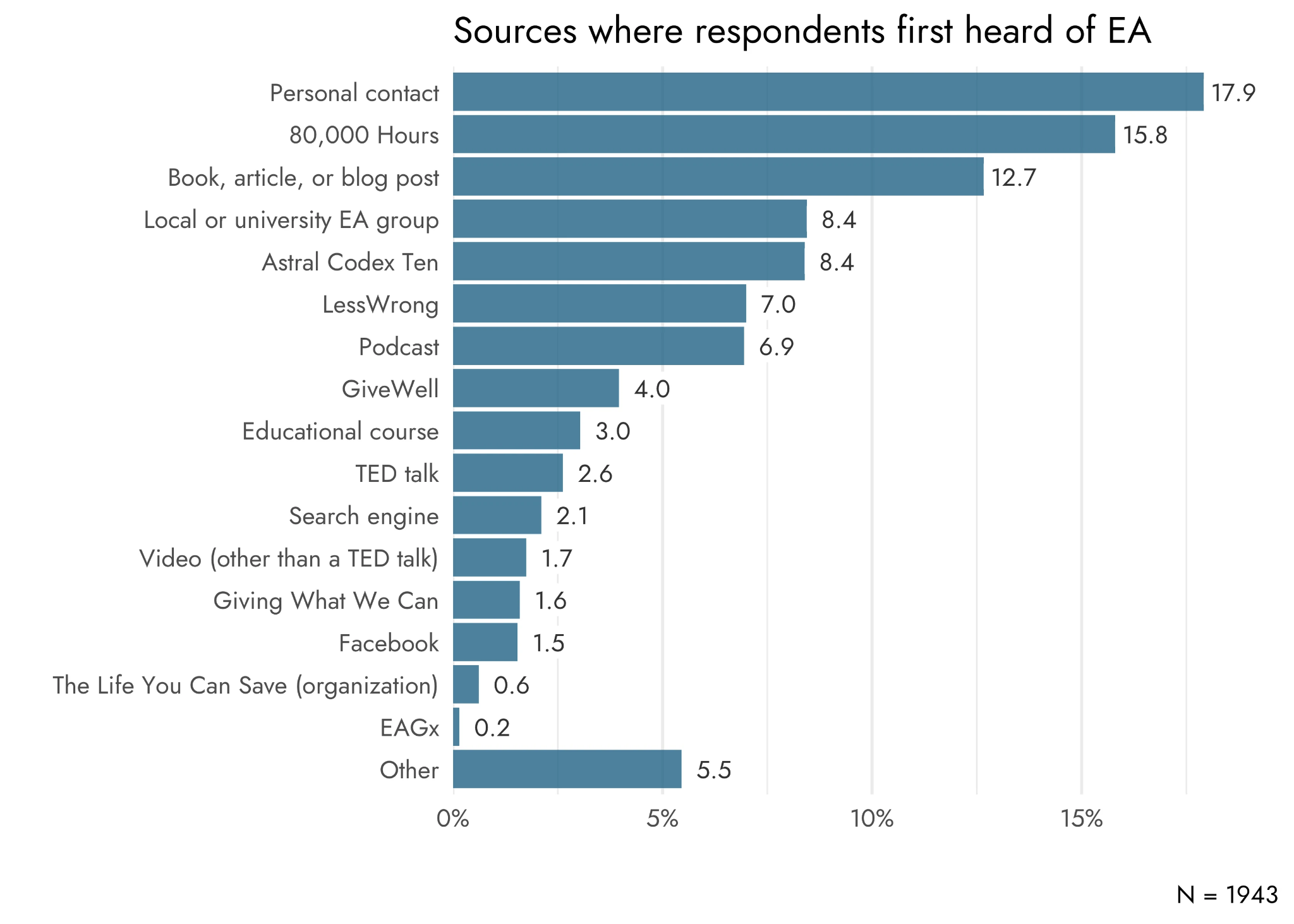
Moreover, I suspect that everything else on the chart is mediated by people’s social circles. For example, I would answer Astral Codex Ten on this survey, but I never would have taken the survey (or done anything with the nice ideas I found on SSC) if I didn’t run into my law school EA group over a year after I started reading SSC.
Despite really liking Scott’s ideas and arguments about EA, it just didn’t make sense for me to start writing checks or pursuing jobs when there was no one in my life who would care that I did those things beyond a “that’s neat” or “good for you, Matt.” And this is to speak only of initial activation energy. I haven’t even touched on sustaining these habits over years. Find a non-impactful job you’re comfortable with? What are the odds you’ll start a new search on your own initiative? Get nervous about money at some point and don’t donate? Don’t worry, we’ll… send you a reminder email? Having someone who cares about these things to actually talk with sounds vastly more effective.
I don’t doubt that there are saints in the world who respond to moral arguments by effectively binding themselves to do what’s right from now until forever — indeed, I’ve had the privilege of meeting some of them — but relying on these types is not going to scale.
Beyond the straightforward offer of social rewards, focusing on forming small groups around EA ideas also preserves fidelity in the ideas themselves. If you’re just passively consuming intellectual content, you can interpret it however you want. It’s not until you have another smart person whose opinion matters to you that you’ll take disagreement seriously or be willing to genuinely ask a [dumb] question and make the effort to learn the answer. Chances are only 1 in 5 people who like EA ideas is going to have the time to go deep on them anyway.
Being less monolithic about career choice can be good for career changes
These two rationales are part of why I don’t like the implicit “jobs first” framing of EA. That framing ties belonging in EA to hirability by top orgs. If people have accurate views about how hirable they are (which we should all want), they’re only going to provide EA-centric social support to hirable people if they, the support-givers, are also hirable. Assuming these social motivations are decisive, that means you only ever get to hire the best-possible people when they all conveniently arrange themselves into groups of five. That is… unrealistic.
Now maybe this is confusing because it has been true that people hired so far have had friend groups like these. But this is survivorship bias. Even those hires themselves will admit (and not even out of modesty) that they are not the single best candidate on earth for their job. That person didn’t apply. And per my story above, one reason they didn’t apply is because their friends — the people whose opinions they care about — wouldn’t consider such a job. Those hypothetical friends might consider donating though, if that were raised in status. Being an enthusiastic subscriber to Asterisk Magazine or the like might even be enough (again, assuming that’s the kind of thing for which we drummed up enthusiasm).
A world awash in impressive, high-context EAs is a world with many more solid, medium-context EAs egging them on. For that, you need to offer attractive alternatives to roles at orgs.
How to do this
I think current practices are somewhat close to what you’d want to do. It’s sometimes said that “the output of a group is its organizers,” meaning that assembling volunteer groups whose nominal focus is pitching their fellow students or city-dwellers on impactful jobs is actually about getting the volunteer group to pitch themselves in the process. Having a shared project of pitching third parties gives the group something to bond over and an excuse to focus on the ideas and learn about the ecosystem.
All you need to do is be a bit more explicit with organizers that their mission is to spend time playing with the ideas in whatever way best causes people to invest social time and energy into them. This broader framing gives more people more permission to spend that time than the jobs framing. Talk about donation opportunities, debate philosophical edge cases, write meta-level think pieces, follow the news, run a pledge drive. People who take these things seriously in a social setting for a couple years will notice when relevant jobs come up and feel motivated to jump at them when it’s a good fit. Having lower stakes activities like these will cause many more people to keep their heads up in this way.
This is fine
Asking people to leverage their personal relationships for “institutional” goals feels like crossing a line for some, but I think this is how everyone does everything. Corporate recruiters throw parties for ivy leaguers and give the interns mentors who take them out for lunch and shoot the breeze. People end up spending much of their time in an office where their adult social life is shaped around the latest gossip or industry news. Plenty of other people meet their closest friends in church groups or sports bars. We don’t bat an eye at these practices because they’ve been so thoroughly normalized in their respective contexts, but niche new ideas are held to a higher standard because any attempt to emulate these looks “too contrived.”
One way to mitigate the appearance of contrivance and the (potential) reality of manipulation is to be very transparent about this. Everyone can be a part-time recruiter of workers or donors or readers and be celebrated for that. We want people to have fun with these ideas because we know some portion of them will pay it all forward. It doesn’t have to be everyone and no one needs to feel an obligation to do more than is enjoyable for them and their friends. The rewards for stepping up and dedicating your career to this stuff will be modest rather than a steep cliff where people feel chewed up and spit out. Churchgoers and line workers don’t particularly envy priests and middle-managers.
Another banger 🔥
People are discussing whether Matt should be the CEO of EA.