
All The Pasts I Can Never Go Back To
She softened hard hearts

It usually takes about six months for me to miss a place. I lived in DC last summer, nominally in a dusty row house room I rented off of facebook marketplace, but I spent virtually all my time at the wework a half-hour walk away where my friends would come in to work their 9-5s. It was the hottest summer in DC in a while, so the 30 minute walk there was often rough, even late and early. The contrast between the deep, hot, humid air outside and the frankly excessive A/C gave me a sensation like the one you get from a sauna and ice bath.
It was rough going. I wasn’t crazy about my job and I didn’t really enjoy much meaningful social time outside of some nice run-ins at the office. I tried playing Breath of the Wild in the living room at the row house, but the TV there started crashing so frequently that it became unviable. I took a day off to try and find an accessible soccer field with goals I could shoot at, and struck out at all four candidate locations I dragged myself through the heat to find.
Berkeley is way nicer—I’ve set up my room to be completely comfortable (and in my opinion beautiful); I love my housemates and my village; the weather is temperate; I’m sleeping better than I have in a long time and I really set my own schedule and priorities more so than I have since summer breaks in high school.
Still, I want to relive last summer in DC. My heart longs for London even more—that place that is so incredible to walk around by myself, but where I never felt more socially isolated. DC is a feeling on the roof of my mouth where the receding heat meets the deeper musical notes of the BotW soundtrack. London I actually feel in my chest cavity. Like loss.
That slightly sinking feeling is the one I have for Taerin and Gloria, deep relationships I could never relax in and commit to. My life as a lawyer in the dead center of downtown Chicago with my three-block commute and high-stakes (but charmed) firm job is an airy feeling in the back of my head. Law school lives in my shoulders. It was a little easier to relax them back then as I looked out the window from the best seat in the quiet-talking area of the library that I would seize for myself every morning at 8:30, including (and especially) on weekends.
Times before law school get fuzzier. I know I commuted by car (and sometimes regional rail) up to the suburban industrial park where I worked. There was also the long and messy saga of getting disentangled from my college girlfriend. There was the numbness and disorientation of losing my mom. It’s strange how steadily the waves of grief have gotten further apart, but they still come, 12 years later, now about twelve months apart. That period I feel in my throat and in my sinus and in my tear ducts.
At the very beginning of that period—when I still should have been in undergrad if not for a rush to graduate and move to New Zealand with my silver1—we got Delia. Well, I got Delia. After my sister and I failed in our venture to pick up 1-3 gray kittens we saw online the previous year, I was tempted to adopt a dog, inspired by my friend Martha who had just done that a year or two before. Mom had some criteria: no shedding and no barking, but otherwise my parents were very permissive about the whole affair despite their personal skepticism.
I don’t know how much I was intentionally fudging or self-deceiving when I settled on pit bull as the breed I wanted to go for. The fact sheet said mild-to-moderate shedding, a claim that was mildly-to-moderately undercut by the sparse, but consistent spread of short dark brown hairs covering the softer surfaces of our house a few months later. It was also the breed of Martha’s dog, Abel, who charmed me with his energy and range of facial expression.
I perused some rescue sites, and was taken aback by how much prettier one dog was than basically all the rest. Thinking back to our experience with the kittens, I assumed she’d have been taken or at least would be by the time we slow-and-deliberate Reardons would make a decision.


That wasn’t the case. My sister and I made a first visit at a shelter where Delia was bouncing off the walls. We took her out for a short walk around the block and she pulled on the leash so hard she sent me tumbling on the February ice just a minute out the door. We came back in and she peed on one of the dog beds in front of us, impatient to start sprinting around the room again. Katie thought Mom and Dad wouldn’t be thrilled about this dog behaviorally, but we should do it anyway.
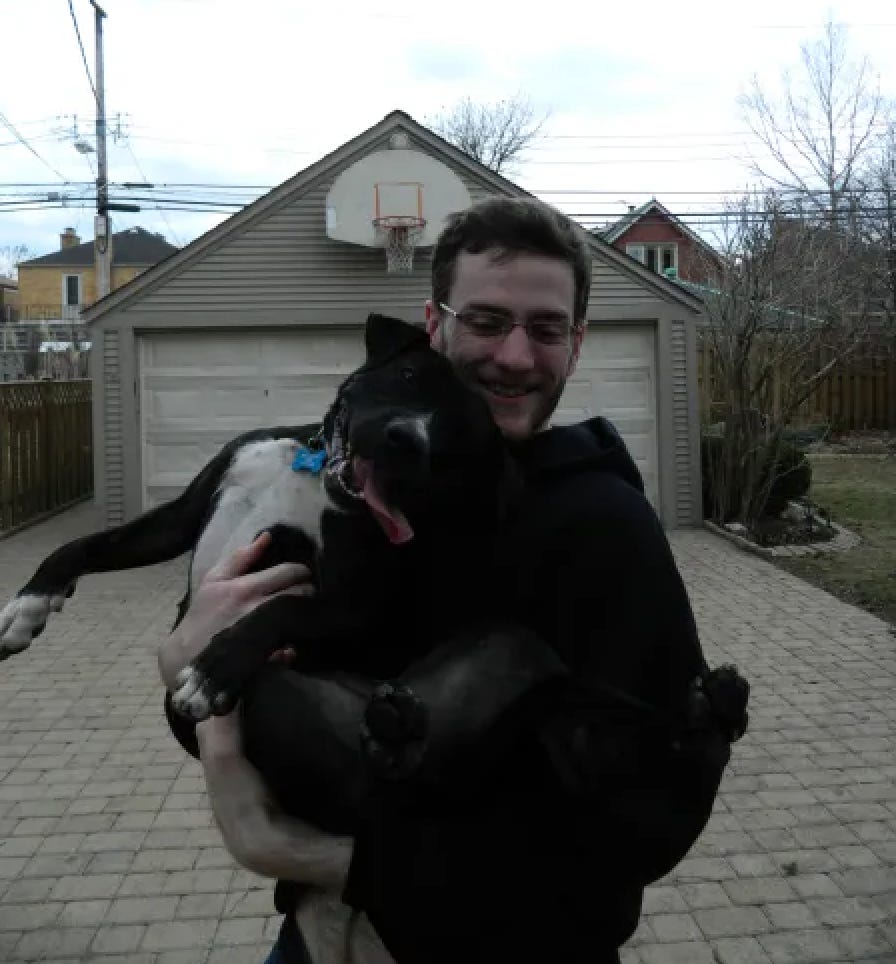
Delia’s rescuer was patient with us and brought her over for a house visit before we committed. Dad was worried about liability. Mom was worried what the neighbors would think about us having a “pit bull.” Again, my parents proved a credit to liberalism.2 Delia came home to us on March 6, 2013, the birthday of our nanny, Czesia, who may have done half the work raising me and my sisters to high school age.
When Delia first came to us, I followed some generic advice about crate training that left her crying through many of her first nights. I can’t remember how long we stuck with it, but it broke our hearts and turned out to be unnecessary. Delia’s gentle demeanor and sense of dignity (occasional zoomies excepted) meant there was no danger to the furniture. She also made it easy to keep at least half my promise to Mom because she wasn’t much of a barker and took the hint that it wasn’t necessary from just a few hits of a (water-only) spray bottle.
The main challenge she posed for us was how to dispose of her excess energy. Thankfully, she never tired of chasing tennis balls. There was a spot you could stand up against the gate to our driveway where, with a little skill, you could throw the ball into the walkway along the side of the garage that went all the way back to the alley. Sprinting back and forth down that 100 foot path on the hard bricks—and putting the brakes on at both ends—probably contributed to Delia’s arthritis later in life, but it was what she lived for. Doing the same on the grass at the park a few blocks away was even better.
2013 was the year Mom was in remission. I’m glad she had Delia in the last year of her life. I can still picture her long fingers scratching Delia’s side and I remember how much Mom appreciated having someone to vent to who wouldn’t ask probing questions, insist on trying to fix things, or otherwise be difficult like her human children and husband. Dad felt the same way. I can’t remember if it was Mom talking about Dad or Dad talking about Mom when they told me it was “the best decision they ever made” to let me bring her home. In a moment of calm heading to the parking lot in the hour after Mom died, Emily said “thank God we have D,” thinking of Dad.
2015 is when Delia became Kevin’s dog. I went off to law school. He was very proud and I don’t doubt very glad for the company in his newfound empty nest. There’s a lot to be said for the structure of daily walks and the feeling of being needed. In general, Dad and Delia got along famously. Delia kept enough of the discipline I instilled in her in her first few months with us that she never took Dad’s largesse with people food as a sign she could tear the house apart or escape the yard as I’m sure Dad would have otherwise let her do.
I would come home for a week every few months and over the summers and get to enjoy some time with D and give her proper workouts in the park. She needed (or at least highly valued) those trips into her old age. We kept the same cadence when I moved downtown.
She was in Florida with Dad for most of the year when I moved back home during the pandemic, but we got the summer of 2021 together before I moved to London. She came in the car with us to the airport and I was really worried I wouldn’t see her again, being so far away and unlikely to come back often. I told her to be good, keep herself alive, and that I loved her.
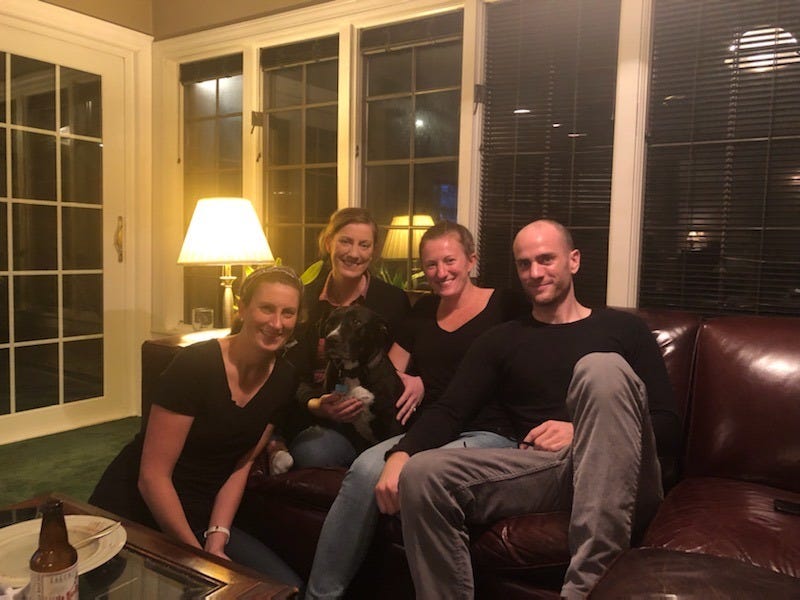
It turns out D had a longevity streak in her. I wonder if it was the somewhat intense research I did on dog food brands when we first got her. Probably not. She and Dad continued going back and forth from Chicago to Sarasota every year up until this one. I got to see her in Chicago after I came to stay with my dad and stepmom after I quit my job in September-October of 2025. I had been surprised she could still chase the tennis ball in the park in 2024, but that was no longer the case. She was still able to muster almost as much excitement at the prospect of a walk or people food as before, but her days of dragging people along the sidewalks and living room zoomies were over.
She and Dad made one last trip down to Florida this winter. My sisters reported back from their visits in January and March that Delia looked pretty bad. Not moving much, struggling to get up and down from short couches, and later, not keeping food down and losing weight. I called Dad, worried that he’d be too married to habit and a desire to deliberate rather than do what was necessary to reduce Delia’s suffering and end our time together on a good note instead of one clouded by pain. I was right to worry. “The vet said it’s not time yet.” Of course, that vet visit was a month ago now, when she was still keeping food down consistently. I didn’t push too hard, but I let him know I would fly in and be there when the time came. I hoped he would take it as a sign to confront reality, if there was a reality to be confronted.
We spoke again a few days later and I made a plan to come down in two weeks. A few days after that, Dad texted me saying “it may be the right time to come down (now).” I was on a plane four hours later.
I got to spend one and a half days with her before the end. She was skinny and lethargic, but seemed tense and had trouble sleeping for long bouts even though she had no energy and could barely move. Twice on the day she died and twice on the day before, she picked herself up and made it to the corner of the patio where she could go potty—the expression I used years before when I’d show her two empty hands as I opened the kitchen door to convey that I wouldn’t be following her out to play. Her heart was pounding on those patio walks and I had to pick her up from two falls. She didn’t like being picked up. She’d tense up even more. Stress to add to the pain. I tried to tell her she could just go inside. The old rules were over now. She just needed to be comfortable.
She would give in to my pleading to take food or water only after I made at least three efforts. This and her brief moments of lucidity and eye contact were my only real signs that maybe she remembered me, maybe she was still here. I liked to think she waited for me, calling back to my sporadic visits of recent years. That’s my own indulgence though. We probably waited too long.
I expected the moment of putting her down to be the most painful thing I’d ever experienced, but almost all the grief came before. Imagining that moment, counting down the hours with her, apologizing for making her wait; praising her for hanging on so she didn’t die in the midst of some terrible seizure. When it did happen though, it happened fast. Maybe I was less present because I couldn’t sleep and there was a stranger in the room, but I stared into her eyes and said the things I wanted her to understand, mostly gently, but sometimes desperately: “You made it D, everything is going to be okay, you did such a good job taking care of us, we love you we love you we love you.”
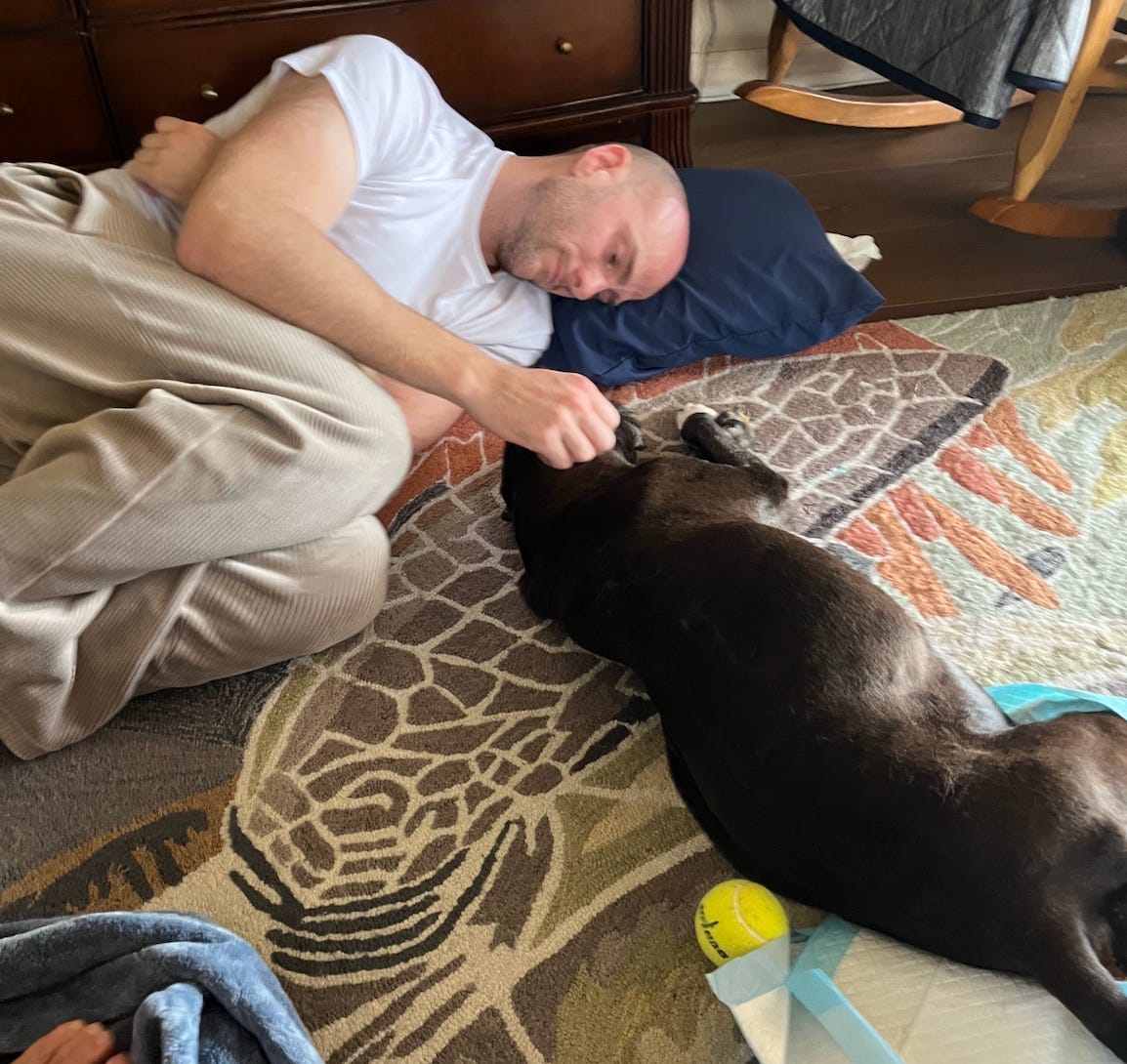
I said the same things to my mom in the room where she died 12 years before. Mom was probably no more able than Delia to grasp those exact words in those final seconds of her life. Both of them were probably already gone in the sense that mattered when I said them. At least when humans get sick and admitted to the hospital they know what’s happening to them and what the range of possible outcomes are. There’s a mutual understanding between the dying and the people they leave behind that this is part of the deal, something they’ve all thought about and something from which they know there’s an imperative to move on and build lives.
Not so with dogs. It feels like we spend our whole lives with them trying to help them feel what we know. Things about love and preciousness without all the cognitive baggage of how things work and our hopes about how life goes after we lose people. Humans know about moving on. Dogs don’t. Grief is the price we pay for love. And a dog’s love is so unmediated by knowledge and intellect—things that so often serve to temper emotion—that the grief hits harder. Some part of me was trying desperately, futilely, to tell Delia “understand what’s happening so you can cope and take the edge off of it.” But all she felt was pain, and love, and then nothing.
She’s another one of my pasts now. One that spanned the last of my formative years, my first romantic love, my first real job, the first time I really left home, saying goodbye to my mom, finding my people, then pursuing what matters to me.
I could go back to DC and walk the same route, go back to the same office, and look up at that same row house. I’ve already done this in London, and Boston, and Chicago. Parts of it fill me up, make me smile. I recognize them. They are now what they were to me then. But those are the thin parts. The façades of buildings and the names of streets. They aren’t who I was then and they aren’t the people I loved and the way I loved them then. Those I can never get back, not the way these feelings in my mouth and chest and throat want to have them back. I am not the same. I’m older and time moves faster. So, so fast. All I can do is create my here and now. Turn to life’s preciousness in hope that I’ll wish I could come back to this past too.
Long story
I was, however, under strict orders for some time only to refer to her as a “Staffordshire terrier,” omitting the “bull” before terrier in her formal breed name
This is beautifully moving, made me cry. Thank you! 🫂
This was so moving to read, I'm sorry for your loss